Accounting Period
Accounts for Financial Year Ending 30th September 2026. Prepared October 2026.
Introduction
This document presents the Club’s financial position for the year ending 30th September 2026 together with the budget for the financial year ending 30th September 2027 and the Club’s 30+ year financial forecast.
For the second year running the Freeagent accounts system has been used and contains the necessary historical data for direct year-over-year analysis.
If you reading this document on a mobile phone, you might want to turn to landscape mode (full screen) so that the charts are easier to interpret.
Independent Examination
The accounts were prepared by Richard Vertigan, Treasurer, Wargrave Tennis Club, October 2026.
The accounts have been independently examined by J D Williams.
1. Highlights
Record membership (up 79% since 2024) has resulted in membership subscriptions increasing by 87% over the same period. Over the last year alone the subscription growth has been 45%. Overall club income in the year has increased to £120k, an increase of 50% over the previous year.
This has helped fund a second padel court and provides the basis for investing in clubhouse improvements going forward.
The Club has cash reserves of £119,000 at the financial year end (of which £87,000 is held in a 35-day access savings account). The cash reserves are partly funded from loans (from members) of £100,000. The first part of the loans (£20,000) was for the first padel court and is due to be paid back in the next financial year. The remaining loan amount will be paid back the year afterwards.
The club currently has record membership as shown below. (15 October 2026).
2. Revenue
Overall the Club's revenue amounted to £120k (an increase of 55% versus the £73k in YE Sep 2025). The chart below details the breakdown of these income streams with 68% (£81k) generated from member subscriptions and 21% (£25k) from court booking fees. £24k of court booking fees was generated from padel court bookings. The remaining 12% income (£13k) was generated from guest of member fees and activities associated with coaching, court hire and bank interest.
2.1 Total Revenue Growth
The chart below shows a period of consistent and accelerating growth from the lowest point in 2021 through to 2026. The growth from 2021 (£33k) to 2026 (£115k) represents a substantial 248% increase. Growth in the year has been 47%.
2.2 Member Subscriptions
£81k of membership subscriptions were received for the financial year ending 30th September 2026. This compares to a total of £55k received in the previous financial year. The chart below shows membership subscriptions since 2017.
The total growth from it's lowest point in 2021 (£26k) to 2026 (£81k) is £55k - an increase of 212%. Growth in the year from member subscriptions is 47%. Growth has been driven by the significant number of new members joining the club as a result of investment in artificial clay courts and padel facilities.
2.3 Revenue From Coaching Activities
Revenue from the Club's coaching agreement has contributed £9k in the financial year (down from £10k). The coaching revenue stream is derived from 10% of the annual turnover of group coaching and holiday camps, a 15% premium for any non-member receiving coaching at Wargrave, and 10% of all entry fees to any LTA tournaments.
2.4 Guest of Member and Court Hire income
Income from the £5/day guest of member fee increased from £2k to £3.5k, mainly due to Padel guests. Hiring out of courts 5 and 6 generated approx £1,300 (£1,124 in previous year). Income from the Padel court itself was £22k which was generated over a 4 month period.
2.5 Bank interest
Bank interest in the year was £1.3k.
3. Expenditure
3.1 Capital Expenditure: 2nd Padel Court
A second padel court was installed in the financial year. This was more complicated and therefore costly than the original padel court as it involved extending the tarmac, moving the fence, rotating and lifting the existing padel court as well as installing the 2nd new court. The total cost of all this work was £88k.
To maintain the clubs financial rule of ensuring bank funds cover a minimum of one years fixed routine expenditure, the initial loan for £20k loan was added to with a further £80k of loans (7 member loans in total). The first loan is due for payback in 2027 and the remainder in 2028.
3.2 Non-Capital Expenditure
Non-capital expenditure in the year amounted to £58k (up from 48k). Of the £58k, the biggest single cost was maintenance which included fence lowering and the repairs to the surface of padel court 9.
Costs associated with adult and junior coaching supervision amounted to £8.5k. Spending on maintenance of the artificial clay courts amounted to £6.7k
A summary of all expenditure is shown in the chart below.
3.3 Energy
In the financial year, energy costs for floodlighting amounted to £3,9k (from £5,5k) and for the clubhouse £1,2k (from £1.3k). Investment in smart remote switches for the heaters helped reduce clubhouse usage. The charts below show the monthly trend since October 2023.
With regard to floodlight costs, there are 4x 800W LED floodlights per court. At 24p/kWh, one court costs £0.77per hour, although courts are lit in pairs so the minimum cost is £1.50/hour. When all 8 courts are floodlit the cost is therefore £6/hour. At 4 hours per night that equates to circa £25/night. Padel court lighting costs 19p/hour.
3.4 Website Hosting, Emails & Social Media
Expenditure on the Club website hosting, broadband and provision of email facilities was £1,495. Continued development of the new website has been undertaken in-house by the Chairman and Treasurer. The costs include broadband, hosting, email, webcams and 'Matchspace'.
4. 2025 v 2026
5. Financial Year 2027
5.1 Fee Increase and Forecast Revenue
For the upcoming membership season (April 2027 to March 2028), we propose increasing membership fees by approximately 3.5%, somewhere between the current inflation rate of between 3% and 4% (depending on the timing and inflation figure used). Returning members would still receive a 10% discount if they renewed in March and before 1st April 2027. With the increase in subscriptions and record levels of members, our forecasted income for YE 2027 is £121k with subscription income of £81k.
5.2 Forecast Routine Expenditure
Forecast expenditure for the year ahead is £56k. This is split into 'recurring' and 'non-recurring' expenditure as detailed in the charts below. Notable increases in expenditure from the previous year are seen on tennis balls (refreshing them more often), electricity (larger clubhouse and increasing number of members using the facilities), grounds maintenance (paying for gardening services). A routine maintenance budget of £6,000 will cover the cost of unexpected expenditure on courts and clubhouse e.g. repairing lights, sewer pump, loos, etc.
- 2027 Capital Expenditure
Capital expenditure in the year is currently budgeted at £115k for improvements/extension to the clubhouse.
6. Future Capital Expenditure & Financial Model
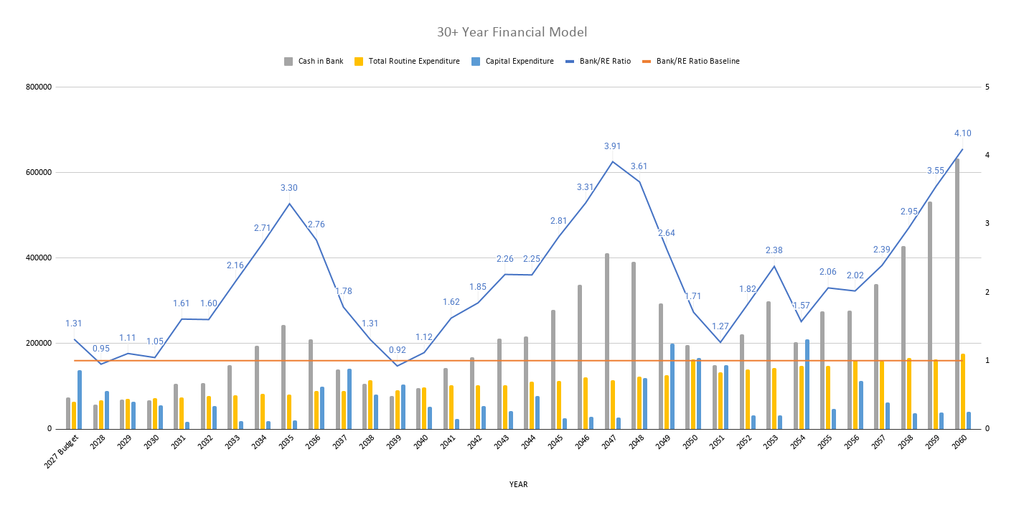
The club's finances are modelled over a 30+ year period. This includes spending assumptions to ensure that all courts are maintained and resurfaced every 12 years, together with provision for other large capital items such as refurbishing courts, floodlighting, fencing and ongoing clubhouse repairs and upgrades.
For the financial year ending 30th September 2027, £115k is included in the budget for a clubhouse extension and improvements. The Committee will respond to feedback from the AGM survey and update the budget with alternative proposals if necessary. In line with the constitution, proposals for any future investment in excess of £24,000 would be subject to membership approval via an EGM voting process.
Future forecasting and planning assumes that the Club will always have a minimum level of cash reserves that matches at least 12 months of routine expenditure (a reserves to routine expenditure of 1:0). The existing financial years starts slightly lower than 1:0 but grows significantly going forward and is considered acceptable.
In the first chart below, grey bars represent cash reserves, blue represents capital expenditure and amber represents total routine expenditure. The second chart shows the detailed breakdown of this capital expenditure. As you will see, with our future spending commitments, our cash reserves still build over time and are in a healthy position.